







Swiss wine | News | Swiss grapes | The best men of the vineyard | Wine tourism | On the table | Once upon a time | In the world |


Last published articles...

The comeback of the sunny days


A very promising vintage, a great success for Arvinis - the major wine event in the region - the reconciliation of the professional organizations, the edition of a new guide devoted to Swiss wine, the launch of various oenotouristic centers around the lake Léman ! This wave of good news foreshadows the opening of an auspicious period for the Swiss wines.


Last but not least, RomanDuVin.ch, born end of April 2005 celebrates its five years of existence. This success, in which few people would have trusted, owes a lots to the faithfulness of our readers. Thanks a lot to all of you for your support, which we hope will remain the same for the five coming years !


Alexandre Truffer
RomanDuVin.ch

[23/06/2010]

Swiss wines, an introductory guide

Vineyards above Sierre, Valais, October 
Swiss wines owe much to the Romans, from names to grape varieties and the expertise that turned fruit into something even more exquisite. After the fall of the Roman Empire, many vineyards were destroyed but monasteries revived them in the Middle Ages. The Swiss rather than the Italians appear to have built the bridges that ensured Italian wine could be brought safely over the border.

Wine, like so much that is Swiss, has undergone centuries of influence by larger, wealthier neighbors France, Germany, Savoy then Italy - and yet it has fiercely retained its Swiss personality.

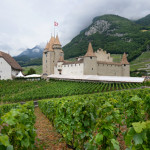
Sion's steep vine-covered slopes below the castle, in Valais
Switzerland’s mini-climates create several excellent pockets for growing grapes. Latitude is right, with most vines grown between the 45th and 47th parallel. Gradients are a curious part of growing grapes in Switzerland: they change the sunlight exposure, a key element in producing good vines. Some grapes are grown on slopes with an 85% gradient. The steep vineyards of Lake Geneva’s Swiss Riviera, around Montreux, and the wine-growing valleys in the Valais, are among the most scenic vineyards in the world.

Rock walls retain heat at night, keeping vineyards warm  
The country’s greatest constraint for wine is, however, altitude, since grapes usually do not grow well over 600m. The foehn, a wind that blows through the Alps, warms many of its valleys. The lakes also help keep temperatures moderate enough for vines. These two factors and rocky terracing that holds the day’s sunlight for a few hours at night make it possible to grow slightly higher. In Visperterminen, Valais, they are pushed to their highest limit in Europe, growing at 1,100m.

Wine-growing areas
Every Swiss canton grows grapes for wine. Valais is the largest wine region, with 5,200 ha, followed by Vaud, 3,700 and Geneva, 1,500. Ticino, the Italian-speaking canton, has 1,200 ha and the German-speaking cantons in eastern Switzerland have a total of just over 2,300, with most (500 ha) of it in Schaffhausen.

Labels and appellations
Wines from Switzerland are generally labelled with their town of origin, grape variety and if they are a "protected" wine, their AOC (Appellation d’origine contrôlée). Switzerland has 658 appellations, or denominations, in 11 cantons. Vaud has the highest number, 173, followed by Valais, with 124. Geneva has 60.

Grape varieties
The main varieties are listed here, but there are also several interesting ones grown on a small scale, such as Syrah in the Valais, and crosses, or hybrids. Switzerland has a long tradition of blending wines, so that one of the best-known red wines from Valais, Dole, can be either 100% Pinot Noir or a blend with Gamay and Pinot Noir making up 80%, although the Pinot Noir must dominate.

White: Chasselas, Sylvaner, Riesling, RieslingxSylvaner (aka Mueller-Thurgau), Pinot Gris, Pinot Blanc, Chardonnay, Gewürtzraminer, Räuschling.

Chasselas is the grape widely grown in Geneva, Vaud and Valais, known as Fendant in the Valais. Several wines experts, among them Britain’s Jancis Robinson, consider that the grape achieves its finest in Switzerland. That said, over-planting for years led to a glut of mediocre-quality wines and you still read erroneous reports today that these are not interesting wines.

Red: Pinot Noir, Gamay, Merlot, Bondola, Humagne Rouge, Cornalin

Prices
Swiss wines of good quality are generally sold in Switzerland within a range of SFr10-30 per bottle. Specialty wines and those produced in small quantity often command a higher price. Switzerland long had a reputation for pricey wines, but in the market in 2006 they compete well pricewise with comparable quality wines from Italy, Spain, France and Germany and are often less expensive than a good-quality American wine.

Posted by Ellen Wallace on 1 April 2007 on Geneva Lunch


[13/07/2009]


<< (1/1) >>

See the archives
Search in the website


RomanDuVin.ch
Advertisement
Links
Copyright
Plan du site
Contact

Newsletter   


Classement de sites - Inscrivez le vôtre!